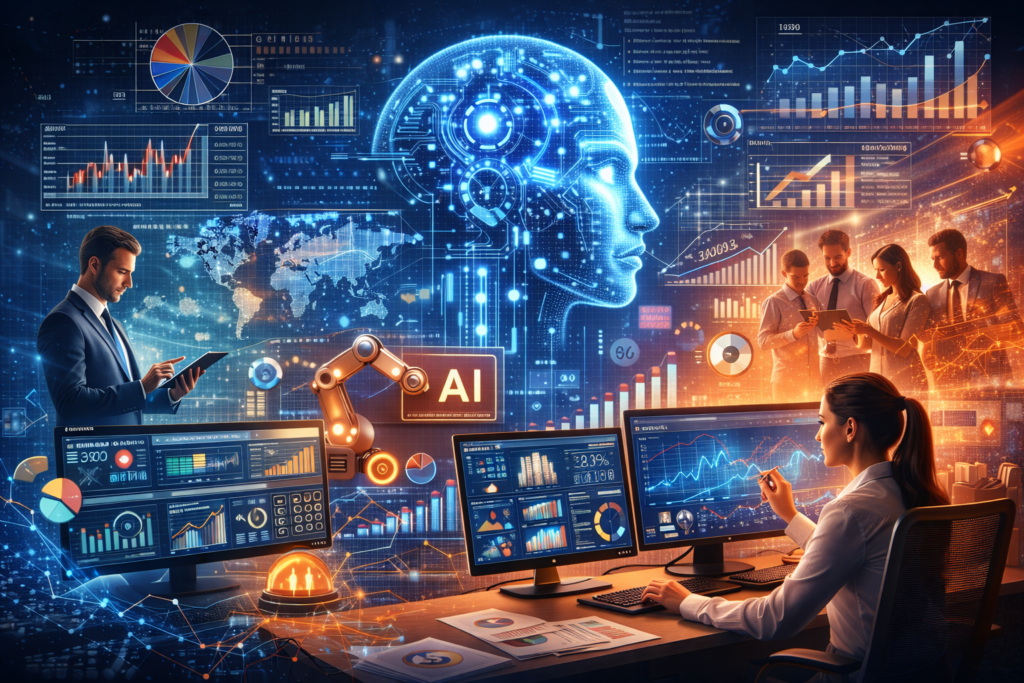
Article on AI and Business Analytics :
In today’s fast-paced digital world, AI and business analytics are transforming how organizations operate, compete, and grow. Businesses are no longer relying solely on intuition or past experiences—data-driven decision-making has become the foundation of success, powered by the integration of Artificial Intelligence and advanced analytics.
One of the most significant benefits of AI and business analytics is the ability to process and analyze large volumes of data in real time. Companies can now gather insights from customer behavior, market trends, and operational performance with greater speed and accuracy. This helps organizations make smarter, more informed decisions that directly impact growth and efficiency.
Another key advantage of AI and business analytics is predictive analysis. AI algorithms can identify patterns and forecast future outcomes, allowing businesses to anticipate customer needs, optimize inventory, and reduce risks. This proactive approach gives companies a strong competitive edge in dynamic markets.
Automation is also a major contribution of AI and business analytics. Routine tasks such as data entry, reporting, and customer support can now be handled by AI-powered systems. This not only saves time and reduces human error but also allows employees to focus on more strategic and creative aspects of their work.
Furthermore, AI and business analytics play a crucial role in enhancing customer experience. By analyzing customer data, businesses can offer personalized recommendations, targeted marketing campaigns, and improved services. This leads to higher customer satisfaction and stronger brand loyalty.
Despite its many advantages, the use of AI and business analytics also comes with challenges such as data privacy concerns, the need for skilled professionals, and the cost of implementation. However, as technology continues to evolve, these challenges are gradually being addressed.
In conclusion, AI and business analytics are reshaping the future of business by enabling smarter decisions, improving efficiency, and creating better customer experiences. Organizations that embrace these technologies today are more likely to succeed in the competitive landscape of tomorrow.